
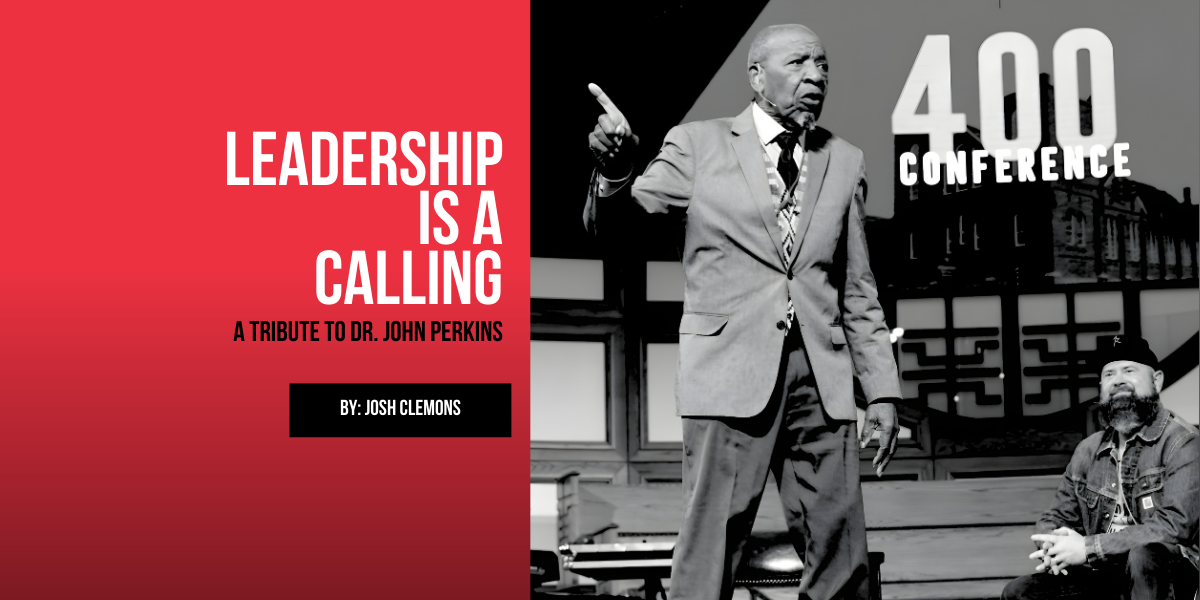

I first met Dr. John Perkins on top of Stone Mountain in 2018.
The symbolism of that place was not lost on any of us. Stone Mountain has long stood as a monument to division in America. Yet that day we gathered to pray and preach about reconciliation in the Church.
When I met Dr. Perkins, he was warm from the start, kind, and full of quiet authority. His southern voice carried both gravity and grace. He pulled me close and spoke to me like an old friend.
I remember him preaching that day with conviction. There was a presence on him that only comes from walking with Christ for a long time.
But what I remember most was something he said publicly and reiterated to me privately:
“Leadership is a calling.”
Then he said something I have carried ever since.
“The thing that will keep you in the fight for a reconciled Church is being anchored to that calling.”
At the time, I was a younger Black man trying to lead a reconciliation effort that often felt far bigger than me. Navigating race, the Church, and the hope that the gospel might still have something to say to our divisions.
I suspect Dr. Perkins saw that.
He knew what I was up against. But he also saw what was possible.
Not long after that gathering, my phone rang.
“Hello Josh, this is John Perkins.”
I remember being stunned. Little old me getting a call from Dr. Perkins.
Over the years, he called a few more times. His voice was unmistakable, fatherly, kind, steady like a beloved coach who had seen the game played for a long time. I still have several of his voicemails.
Those calls meant more to me than he probably realized. They reminded me that the work of reconciliation is not something we carry alone. It is something passed down, stewarded, and shared across generations.
Dr. Perkins spent his life calling the Church back to something simple and costly.
Love.
Not sentimental love.
But the kind of love that crosses racial lines, bears one another’s burdens, and refuses to let division have the final word.
For decades, he warned the American Church about a danger greater than disagreement.
A loveless Church.
A Church that reduces the gospel while losing the very thing that makes it credible to the world.
Dr. Perkins believed reconciliation was not a political project.
It was the gospel itself.
The cross reconciles us to God.
And the cross sends us toward one another.
That message was costly when he first preached it in Mississippi during the civil rights movement. It is no less costly today.
Because the truth is, we are living in another moment of profound division.
Suspicion and hostility shape our politics.
Fear shapes our conversations.
And far too often those same divisions find their way into the Church.
Christians speak past one another.
We sort ourselves into tribes.
We defend our positions more passionately than we pursue one another in love.
Dr. Perkins warned us about this long ago.
He feared a Church that would forget its defining mark.
Jesus was clear: the world would know we belong to Him by our love for one another.
Not by our arguments.
Not by our influence.
Not by our ability to win cultural battles.
By love.
Dr. Perkins believed this with his whole life.
And yet he was never naïve about the difficulty of that work.
He had suffered for it.
He endured beatings, imprisonment, and the brutal realities of Jim Crow Mississippi. He knew what it meant to preach reconciliation in a nation that had violently rejected it.
But he never lost hope.
Not because he believed people would suddenly become better.
But because he believed in the power of Christ.
His gaze was fixed firmly on Jesus.
He often reminded us that the power for transformation does not live in any one individual.
“We think the power is in us individually,” he once told me. “However, the power is in us collectively. It is in the Church.”
That conviction shaped everything he did.
Dr. Perkins believed that if the Church would truly follow Jesus, if we would humble ourselves, repent honestly, and love one another across every dividing line, the gospel would still have power to heal what hatred has broken.
The last time I saw him was in 2023 on a Sankofa trip. When I walked in, he knew exactly who I was.
He smiled and said he had been hearing good things and that he was profoundly proud of me.
That moment meant more than I can fully explain.
Dr. Perkins deposited something into my life, and into the life of the Church.
His witness cannot end with his passing.
If anything, his words feel more timely now than when he first spoke them.
Because the Church today stands at a crossroads.
We can continue down the path of suspicion and division, allowing the culture’s fractures to define us.
Or we can return to the costly love of Christ.
We can tell the truth about our past.
Repent where we have failed.
And love one another across the very lines the world tells us cannot be crossed.
Dr. Perkins spent his life reminding us that this is the work of the gospel.
And perhaps the greatest way we can honor his life is not simply to remember his words.
But to live them.
To raise the conversation on reconciliation back to love.
To remind the Church that our greatest distinction is not our politics, our tribes, or our arguments.
It is love.
And when the work feels heavy, I still hear his voice.
“Leadership is a calling.”
“You’ve been called.”
May we carry the work forward.